How to play the crash game: a step-by-step walkthrough
It looks dead simple from outside — a plane takes off, the multiplier climbs, and you grab your money before the thing blows up. But there are a few small details I learnt the hard way, and they make all the difference. So here's the whole journey, right from opening an account to collecting your very first win.
How one round actually works
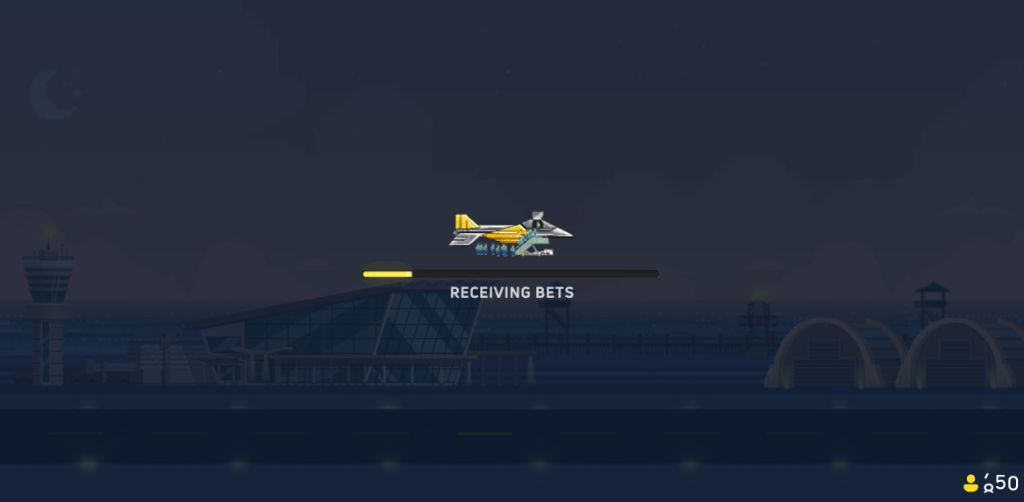
Every round follows the exact same script. First the system opens the betting window — you'll see "Receiving bets" pop up while the plane is still sitting on the runway. That's your moment to place a stake. The instant the window shuts, the engine roars, the plane lifts off, and a number in the middle of the screen starts ticking up: 1.00x, 1.20x, 1.64x and onwards.
Now here is the catch. The flight can end any second — sometimes it crashes at a sad 1.05x, other times it shoots way past 8x and keeps going. The crash point is decided by a random number generator before the round even starts, so nobody on earth can guess it. Your one and only job is to tap the cashout button before the plane blows. Pull it off, and your stake gets multiplied by whatever number was showing. Miss it, and the stake is gone.
Get a feel for the rhythm. There's a short pause between rounds to collect fresh bets, then the flight itself, which runs anywhere from a couple of seconds to about half a minute. In one hour of solid play you might watch a few hundred rounds go by, so discipline and pre-set limits really matter here — more than people expect.
The fairness side of it runs on Provably Fair technology. Each result is locked in beforehand through an encrypted value (a hash) that can't be touched once the round begins. After the flight ends, the system reveals the original data, and anyone who wants can verify for themselves that the crash point was never tampered with mid-flight. That's exactly why seasoned players trust crash mechanics — the outcome can't be nudged in favour of the casino or the player.
The studio quotes a high return-to-player figure (RTP) of roughly 97%. In plain words, over a very long run, for every hundred units staked about ninety-seven come back. But please remember — RTP is a statistic measured across millions of rounds, not a promise for your particular session. In a short burst the swing can be brutal: you could drop ten rounds in a row, or catch a multiplier above fifty out of nowhere.
Creating an account and adding funds
To play with real money you'll need an account on a site that offers this game with Indian rupee support. The whole thing takes just a few minutes.
- Step 1. Tap the "Play" button to land on the operator's site.
- Step 2. Hit "Register", drop in your phone number or e-mail, and set a password.
- Step 3. Pick INR (rupees) as your account currency.
- Step 4. Confirm you're above 18, and complete the KYC check if they ask for it.
- Step 5. Open the cashier and choose how to deposit — UPI, Paytm, PhonePe, net-banking or crypto.
On most sites the minimum deposit is tiny, and a UPI top-up usually lands instantly. For your very first go, don't pour in big money — just keep a budget you'd be okay spending on a bit of fun, with no regrets later.
"Honest tip from us: keep one separate payment method only for gaming and set a daily limit on it. That's the easiest trick I know to stop yourself going over budget."
Your first bet in six steps
Once the account is funded, you can place a stake. Just follow this simple order.
Open the game
Find the title under Instant Games or Crash, or simply type the name into the casino's search box.
Set your stake
Punch in an amount in the "BET" box. Use the quick buttons (20, 50, 100) or type your own value.
Wait for the betting window
A bet only counts during the "Receiving bets" phase, while the plane is on the runway.
Watch the multiplier
After lift-off the number climbs. Decide where you want to lock your win.
Hit COLLECT
Cashout grabs the current multiplier. The whole game is to do it before the crash.
Check your balance
The win hits your account straight away. You can review every bet under "My Bets".
Reading the game screen
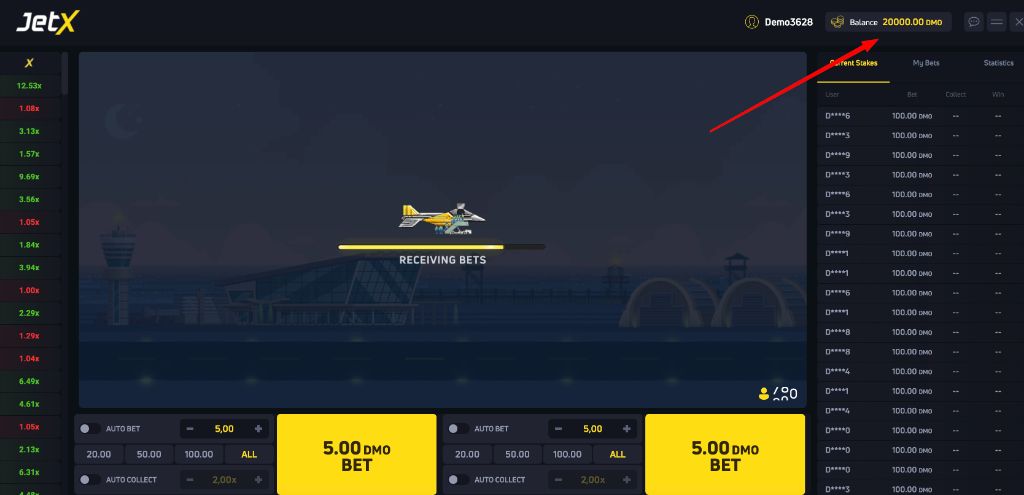
The layout is sensible and not cluttered at all. Here are the main zones, so you feel at home from the very first launch.
The history strip
On the left you'll see the results of past rounds: 1.05x, 12.53x, 3.13x and so on. Loads of newcomers stare at this strip hunting for a pattern — but trust me, every round is independent, and history tells you nothing about what comes next.
The flight field
The centre shows the plane itself and the live multiplier in big bold digits. The background shifts depending on how long the flight runs — from a daytime runway right up to open space when the multiplier gets really high.
The bet panel
At the bottom sit two bet blocks (for the double-bet mode), the auto-bet and auto-cashout fields, plus quick buttons to pick a stake.

Balance and the bet table
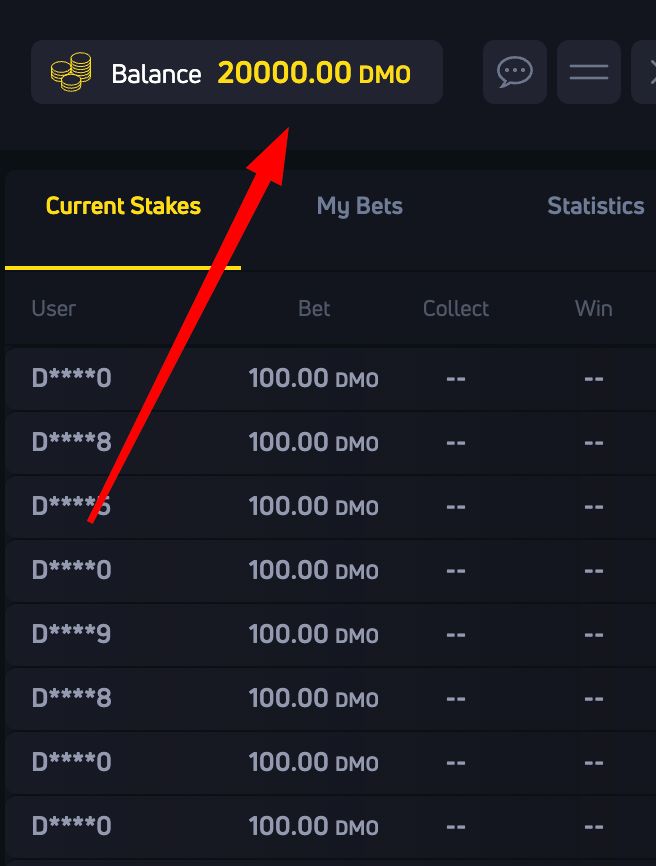
Up top you'll spot your balance, and on the right a "Current Stakes" table showing other players' bets in real time. It gives a nice sense of playing together and lets you see who cashed out, and for how much.
Auto-bet and auto-cashout: playing without emotion
These two automation tools help you stick to your plan and stop the heat of the moment taking over.
Auto-bet
Switch this on and a fixed stake goes down automatically in every new round. Very handy when you want to play long series on one tactic without tapping the button each time.
Auto-cashout
Here you set a multiplier in advance, and the system grabs the win for you. Say you set 1.80x — the win locks in by itself the moment the number hits that mark. This saves you from greed, which honestly is the number one reason people lose at crash games.
Combine the two and you get a semi-automatic session: the bet places itself, the cashout fires at your chosen multiplier, and all you do is watch the overall result and know when to stop.
Series play
Auto-bet removes the grind during long sessions on a single strategy.
Discipline
Auto-cashout locks profit at a pre-chosen mark, no second-guessing.
Pace control
Automation stops you "revving up" and staking more than planned.
Try playing your first round
You’ve got the theory down — now go practise. Start with a tiny stake on a trusted site and put this guide to work.
Play NowHow to take your winnings out
Withdrawing mirrors depositing. Once your balance is above the site's minimum, run through a few steps:
- Open the "Cashier" or "Withdraw" section in your account.
- Enter the amount (usually from the site's set minimum).
- Choose a method — most often the same UPI or a bank transfer.
- Confirm the request and complete identity verification if asked.
- Wait for the credit. Through UPI the payouts generally come quickly.
If you haven't done KYC yet, the operator may ask for documents before your first payout — that's a standard anti-fraud step, not a roadblock. Keep an ID handy ahead of time so nothing holds up the payment.
Paying with cryptocurrency
Apart from the usual Indian methods like UPI, Paytm and PhonePe, plenty of sites also accept cryptocurrency. Topping up with USDT, Bitcoin, Ethereum or TON suits anyone who values speed and privacy — the transactions move straight through the blockchain, with no middlemen and no long bank delays. Crypto payouts usually land within minutes, and fees on networks like TRON or TON are next to nothing. Before your first crypto deposit, just double-check you've picked the correct transfer network — sending coins on the wrong protocol means losing them.
Crypto is especially useful in regions where bank cards face limits on payments to gaming services. A wallet takes a couple of minutes to create, and the rupee conversion rate shows right inside the operator's cashier. Still, keep volatility in mind: a coin's value can move between your deposit and your withdrawal, which is why stablecoins (USDT, USDC) are seen as the most predictable option for play.
Playing from your phone
The vast majority of Indian players open crash games right on their phones, and there's good reason for it. The light engine doesn't need a powerful device and loads fast even on a shaky mobile connection. The controls are fully built for touch — a big bet button and an even bigger cashout button sit at the bottom of the screen, easy to reach with your thumb.
You can play two ways — through the operator's mobile site in a browser, or through an installed app. The browser route needs no download and no updates, while the app runs a touch more smoothly and pings you with bonus notifications. A 4G connection is plenty for comfortable play; on a weak signal, better to put the session off, because interface lag can cost you the very second you needed to cash out.
What to check before a mobile session
- Battery level — it stings to lose a round to a sudden shutdown.
- Connection stability — Wi-Fi beats a crowded cellular network.
- Turn off auto screen-lock so the display doesn't go dark mid-flight.
- An up-to-date browser or app so the interface renders correctly.
Seven rookie mistakes
So your first taste of the game doesn't end in disappointment, steer clear of these classic slip-ups.
- Playing with no limits. No loss ceiling is the fastest road to an empty balance.
- Chasing huge multipliers. Greed at x10 ends in a crash far more often than a win.
- Chasing losses. Doubling stakes "to win it all back" drains the account in no time.
- Believing in "predictors". No software on earth guesses a random result.
- Hunting patterns in history. Past rounds have zero pull on the next one.
- Playing on emotion. Tiredness and adrenaline wreck your decisions — take breaks.
- Betting your last rupees. Only ever play with money you can lose and still sleep fine.
"The single best skill in crash games is knowing when to walk away — not just from a round, but from the whole session. Locked-in profit is only real once you've actually stopped."